
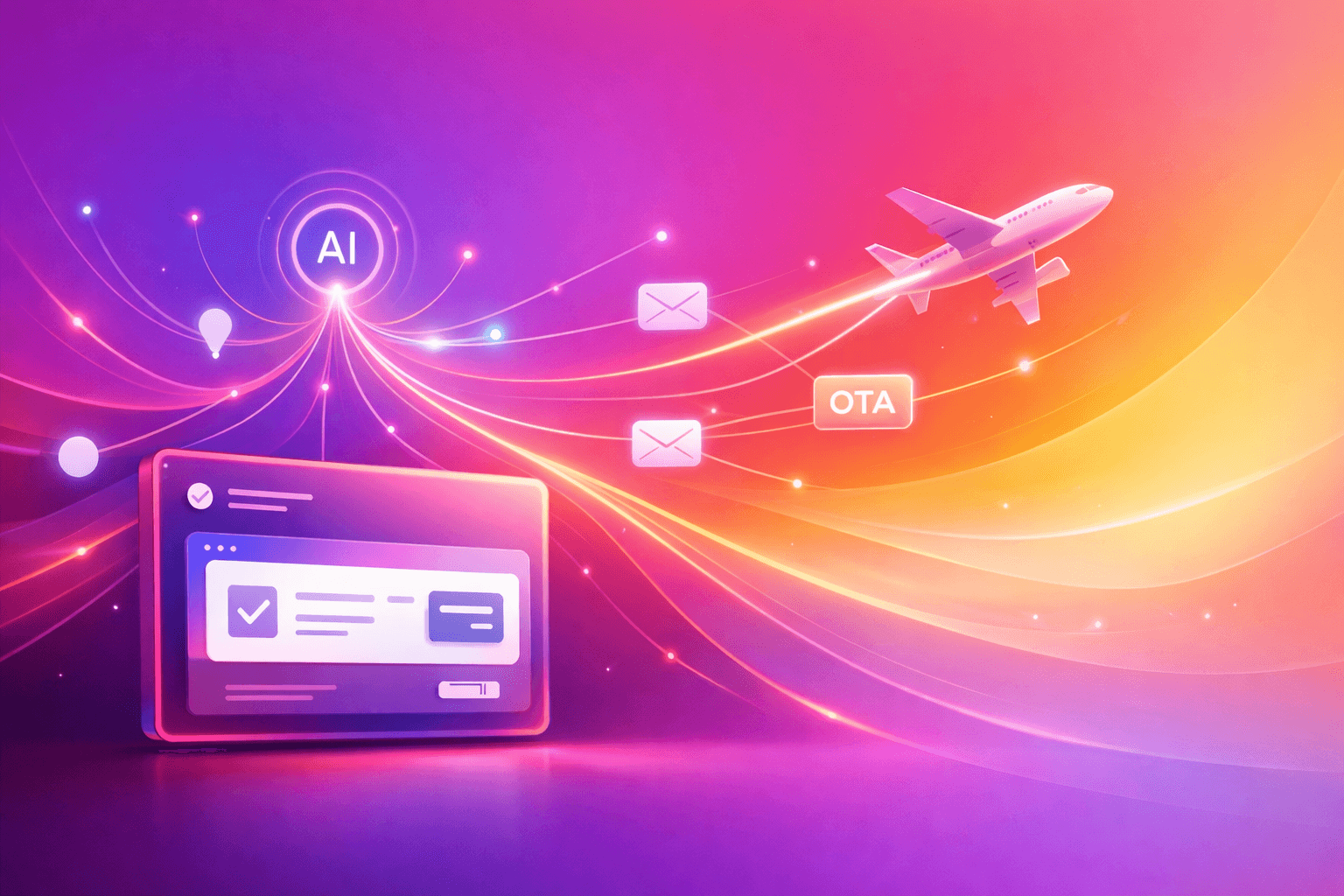
AI agents are quickly moving from “help me plan” to “book it for me.”
What started as conversational search is becoming transactional execution — where software doesn’t just recommend options, but completes purchases on behalf of users.
Stripe recently described this shift as agentic commerce: a new model where AI systems act as machine customers, discovering products, making decisions, and executing payments end-to-end.
In travel, this shift has massive implications.
Because when AI agents start booking flights, the most important question isn’t who recommends the flight — it’s:
Where does the booking actually happen?
The risk: if agents can’t book direct, they default to OTAs
Today, OTAs dominate not because they offer the best brand experience, but because they are machine-ready:
Clean, predictable APIs
Normalized inventory and pricing
Deterministic checkout flows
Centralized identity and payments
From an AI agent’s perspective, OTAs are simply easier to transact with.
Airline websites, on the other hand, were built for humans — not machines.
Legacy booking flows, fragmented identity, brittle payments, and inconsistent outcomes make direct airline checkout difficult for agents to automate.
So when an agent is tasked with “book the best flight”, it follows a simple rule:
If direct booking isn’t reliable, route demand to an intermediary that is.
That’s how agentic bookings quietly become AI-powered OTAs.
This is exactly the problem Stripe is warning merchants about
In its agentic commerce research, Stripe highlights a clear risk:
If merchants don’t expose structured, machine-readable, executable commerce surfaces, they risk becoming suppliers inside someone else’s platform — rather than owning the transaction themselves.
Travel is especially vulnerable.
Flights are high-value, high-complexity purchases with payments, loyalty, ancillaries, and compliance layered in. If airlines don’t adapt quickly, AI agents will naturally route bookings to whoever can complete the transaction reliably.
MCPs: the bridge between AI agents and real-world transactions
This is where Model Context Protocols (MCPs) come in.
At a high level, MCPs define how AI agents interact with external systems in a predictable, auditable, and safe way. Instead of scraping websites or relying on brittle automations, agents call well-defined tools with:
Structured inputs
Clear permissions
Deterministic outputs
Explicit failure states
In commerce, MCP-style integrations are what allow agents to move from reasoning to execution.
But here’s the catch:
Most airline checkout stacks are not MCP-ready.
Movmo’s role: MCP-ready execution for airline direct bookings
Movmo isn’t an AI agent.
And it’s not a marketplace.
Movmo is the execution layer that sits underneath airline booking flows — designed so both humans and machines can complete transactions reliably.
From day one, Movmo Profile has been built to align with MCP principles:
Structured booking objects instead of UI-dependent flows
Deterministic checkout states (initiated → confirmed → ticketed → failed with reason)
Reusable traveler identity without forcing airline account creation
Tokenized, agent-safe payments
Clear permission scopes for delegated actions
This means AI agents don’t need to “figure out” airline checkout.
They can simply execute it — directly on the airline’s website.
Why this matters now (not later)
Airlines don’t have years to re-platform.
Agentic commerce is arriving faster than most legacy systems can evolve, and OTAs are already positioning themselves as the default execution layer for AI.
Movmo helps airlines skip the rebuild.
With minimal integration effort, airlines get:
An MCP-ready checkout surface
A single execution layer agents can trust
Protection against AI-driven OTA displacement
Direct ownership of the customer, payment, and loyalty relationship
In other words:
Movmo helps airlines catch up to the agentic future — without losing control of the booking.
The future isn’t “AI vs direct.” It’s who controls execution.
AI agents will book flights. That part is inevitable.
What’s not inevitable is where those bookings happen.
If direct checkout isn’t machine-ready → demand flows to OTAs
If direct checkout is MCP-ready → agents can book direct
Movmo exists to ensure the second outcome.
Not by building chatbots.
Not by becoming another marketplace.
But by making airline checkout infrastructure for the agentic era.
Want to stay direct in an AI-driven world? → Book a demo
👉 If you want to be first in line to try Movmo Profile, join our waitlist.
PS: Want to see where this is going? Sign up below and get an early look at how we’re rebuilding airfare booking from the ground up.
You Like Traveling. We Like Talking About It.
Join the newsletter squad. Stories, hacks & updates worth opening.