
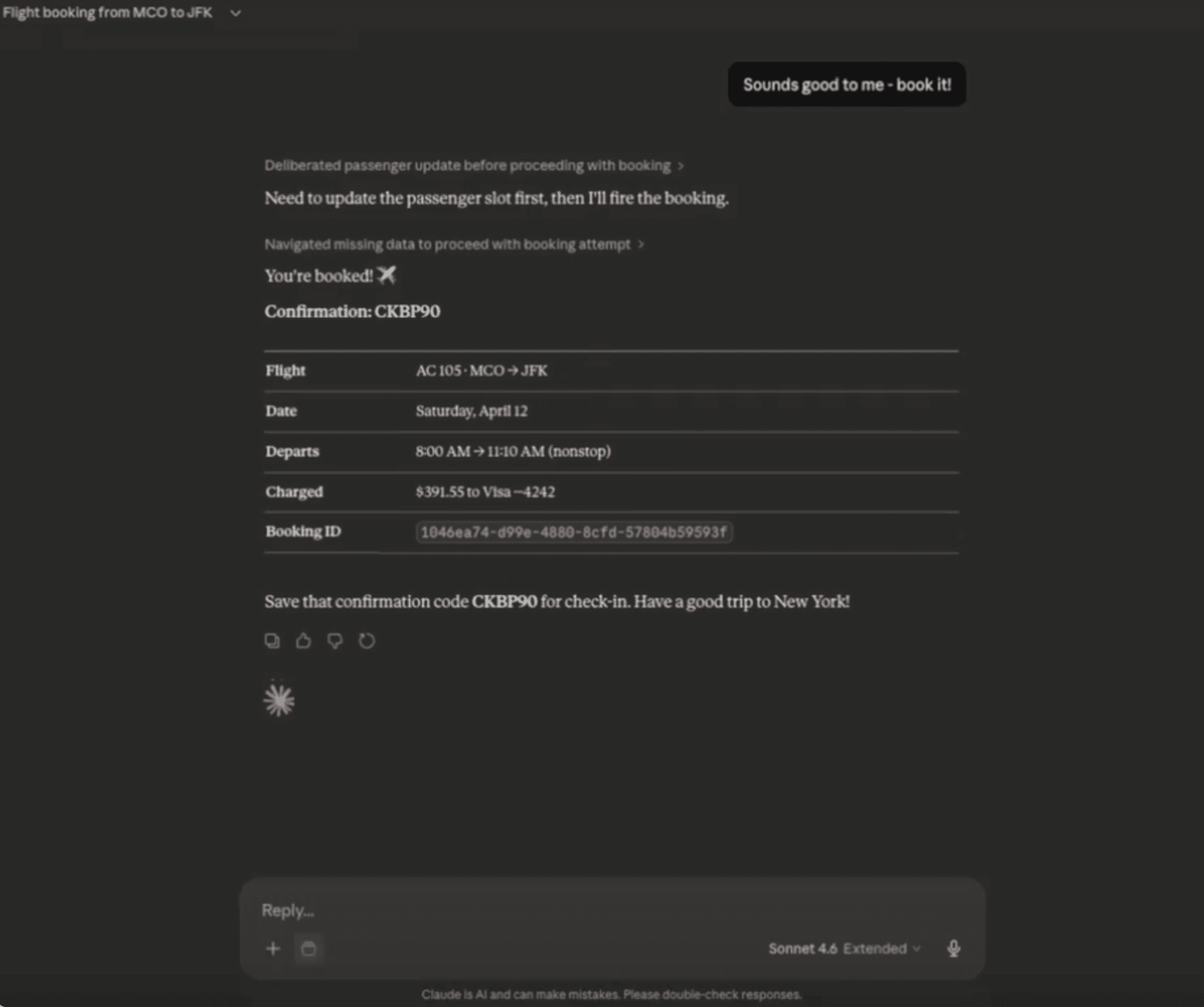
We recently connected an AI agent to an airline’s live inventory and completed a real booking.
Not a mock.
Not a sandbox.
A real transaction.
Under the hood, this was powered by an MCP-style architecture that allows AI agents to interact directly with airline systems.
If you’ve been following the hype around AI in travel, that probably sounds like the milestone.
It’s not.
The industry is focusing on the wrong problem
Everyone is building:
AI travel assistants
Chat interfaces
Trip planners
But very few are solving the thing that actually matters:
Can the AI complete a real booking on real airline infrastructure?
Because that’s where things break.
Airlines don’t have a UX problem. They have a systems problem.
Turning “book me a flight” into a valid ticket requires:
Real-time availability
Pricing logic
Fare rules
Passenger data validation
Payment + ticketing
That entire chain has to work perfectly.
And it has to work inside systems that weren’t designed for AI.
This is why most AI travel demos stop before checkout.
This isn’t new. It’s the same problem airlines have always had.
Airlines don’t make much money flying passengers.
In fact, the industry is expected to make around $7.90 per passenger on average .
That’s not because demand isn’t there.
It’s because the infrastructure behind the transaction is incredibly complex and fragmented.
So airlines compensate:
Loyalty programs
Credit cards
Ancillary revenue
Not because they want to.
Because they have to.
AI doesn’t fix this. It exposes it.
AI makes it easier to generate intent:
“Find me a flight”
“Book the cheapest option”
“Change my return to Friday”
But intent is useless if it can’t be executed.
So the real shift isn’t AI interfaces.
It’s what sits behind them.
The real opportunity: the transaction layer
If bookings move into AI assistants, the question becomes:
Who actually completes the transaction?
Not:
Who owns the interface
Who generates the demand
But:
Who can reliably turn AI intent into a valid airline booking?
That’s a different layer of the stack.
And it doesn’t exist yet in a clean, scalable way.
Why this matters for airlines and PSSs
Over the next 12–24 months:
AI assistants will become a real distribution channel
Airlines will be asked: “Can your system support this?”
PSS providers will need to prove compatibility
This won’t be optional.
It will be table stakes.
What we’re building toward
The demo isn’t the product.
It’s proof that:
AI can connect directly to airline systems
Bookings can happen without an OTA
The airline can still own the transaction
But more importantly:
It highlights where the industry needs to go next.
Because booking is just step one.
Servicing, changes, disruptions — that’s the next frontier.
AI booking is coming.
But not because of better chat interfaces.
Because the infrastructure is finally starting to catch up.
And the teams that understand that layer—
not just the UI—
are the ones that will shape what comes next.
Want to see how it works? → Book a demo
If you’re a traveler:
→ Join the waitlist and get early access.
PS: Want to see where this is going? Sign up below and get an early look at how we’re rebuilding airfare booking from the ground up.
You Like Traveling. We Like Talking About It.
Join the newsletter squad. Stories, hacks & updates worth opening.